

How To Set Up Duty Belt
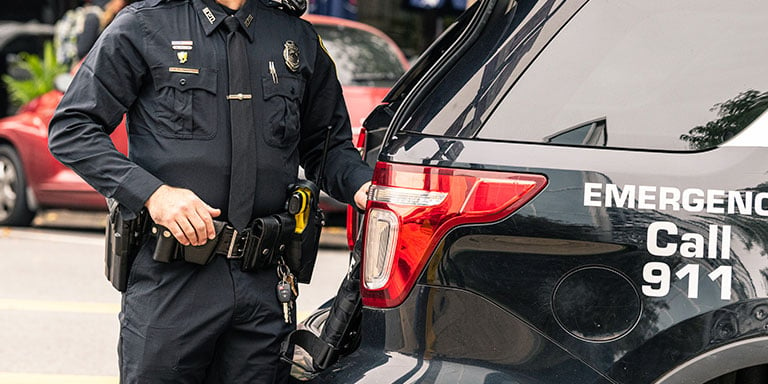
Most police force academies provide recommendations on setting up a duty belt. Even so, organizing your chugalug is an ongoing trial-and-error procedure. Many times, you tin tell the years an officeholder has been on the street by how they wear their duty gear and what they cull to carry.
- How to Position Your Duty Belt
- Essential Backup Equipment
- Testing out Your Duty Belt
- How to Choose Your Equipment
How to Position Your Duty Belt
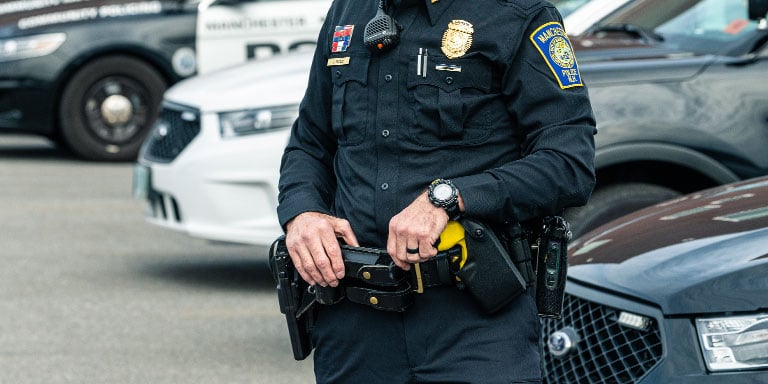
Positioning your belt is a process. No 2 officers are alike — we come up in all sizes and shapes. The fundamental is a balance between functionality and comfort. Functionality refers to the ease of cartoon or accessing equipment yous need under stressful situations. When wrestling with a suspect, you demand to pull your handcuffs in one rapid motion without a lot of thought.
Comfort is an equally of import consideration. When y'all're riding in a patrol car for extended periods, if something is digging into your dorsum, information technology won't final long there. You'll likely accept to move it and replace information technology with something else.
Proper residuum is also of import. Wearing 10 or more pounds of gear on your duty belt will affect your posture and lower back over fourth dimension. To lessen this effect, evenly distribute heavier items on your belt. Start with the proper placement of the sidearm. This will exist on the officer'southward hip on their strong side. Items of roughly equal weight, like your portable radio and expandable baton, are placed on the weak / support side.
A mag-pouch and pepper spray should be toward the front of the belt on the weak side. The officer'due south handcuffs, which are often carried apartment against the lower back, counterbalance these. Ii single gage cases work well in this location. A double-stack cuff case may need to be relocated to the front of the officeholder's belt.
Essential Backup Equipment
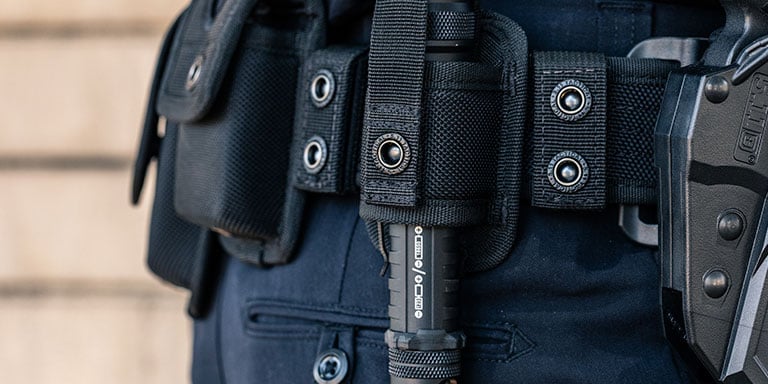
Several disregarded items should be considered for your duty belt. For instance, a handcuff key concealed somewhere on the back of your belt. Try putting a key inside a chugalug keeper and then forget nearly it until it's needed. A worst-case scenario would involve being disarmed and handcuffed in a earnest state of affairs. That subconscious key could be a lifesaver. It's as well a handy fill-in to uncuff someone when you don't take your regular key. Store Duty Accessories
Some other essential is a backup flashlight. Every officer carries a vivid low-cal, especially on the nighttime shift, but flashlights have a way of failing at the worst possible time. Consider your light failing during a human foot chase of an armed robber through a swampy wood on a pitch-blackness night. Getting the picture? A small backup flashlight on an officer'south belt is essential.
Shop Tactical Flashlights | Learn more virtually how to choose a tactical flashlight.
Testing out Your Duty Belt
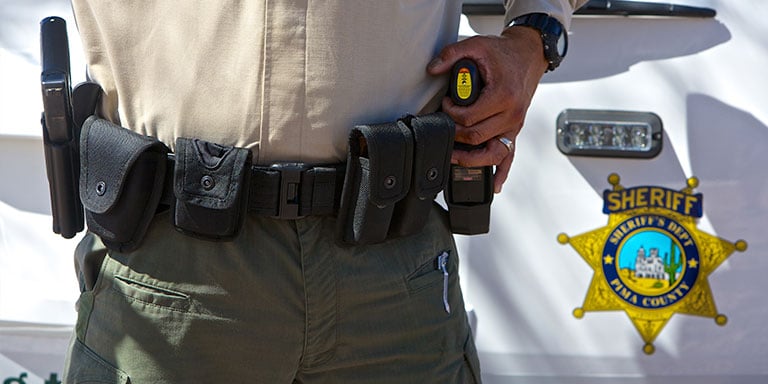
It'due south important to wear your full duty belt to the range during each pistol qualification. You need to do cartoon your firearm and reloading from the duty belt. Officers should never be pulling magazines from anywhere except where they regularly carry them. These learned motor skills go automatic so you don't have to look or even think nearly where to reach for a fresh magazine. Both expandable batons and pepper spray should likewise be drawn with that same automatic muscle memory.
At present you lot've fix your belt, positioning equipment to be comfortable, functional and weight balanced, you're done, right? Not so fast — and that's meant literally. While still on the pistol range wearing your full duty gear, information technology's now time to see how you office wearing your equipment.
Starting time, take a warm upwardly jog while at the range. Officers should exist aware how well the gear remains secured to the body. Once warmed upwardly, complete several total speed forty-grand dashes — the kind of activity you lot tin expect during a pes hunt. How does your duty gear react? Practise all items stay secure, or do they bomb around? Or worse, do they dislodge and drop from your chugalug? It happens. Make the necessary adjustments and then your equipment moves with you and doesn't impede your speed.
You should consummate one final examination, a test many officers are asked to complete at pre-raid briefings. Hop up and down several times. Hear annihilation? Stealth is essential in the everyday life of a patrol officeholder. A silent approach when reacting to a crime in progress or when clearing a residence is vital. Keys and key holders are major offenders, only they don't have to exist. Go on a broad prophylactic ring handy and wrap it effectually your keys — no more jingle-jangle, problem solved.
Before selecting optional duty gear, it's essential to know your section's rules and regulations. While some departments used to mandate most all issued equipment, most have go less stringent over fourth dimension. Today's officeholder wants to deport the highest quality gear they can purchase, as their lives may depend on it. Store Duty Carriers
How to Choose Your Equipment
Duty Belts
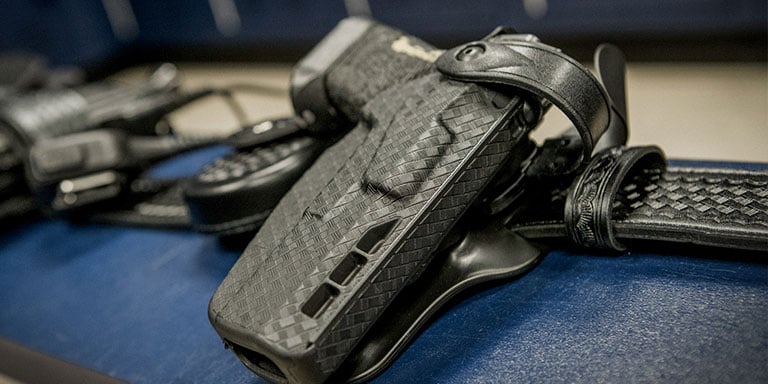
To choose a duty belt, you must kickoff decide how you will wear information technology. There are 3 bones approaches. The old school method is to advisedly thread the duty belt through each piece of equipment and and then the corresponding trouser chugalug loop so all the gear ends up in the proper location. Information technology gives a very neat appearance, specially on lean officers. The downside is that it takes quite a scrap of time to thread each particular onto the belt. It likewise takes a lot of time to remove the belt from the compatible pants.
A significant improvement on this problem is the belt keeper arrangement. The officer wears an inner leather chugalug through the trouser belt loops. They and then affix an outer duty chugalug to the inner chugalug with a series of snap or Velcro belt keepers. Usually six or more keepers hold a duty chugalug in place. The most significant advantage of the keeper system is that once you unsnap the keepers, the unabridged duty belt comes off in one slice with all the equipment. It makes getting in and out of uniform much quicker. Shop Duty Belt Keepers
The tertiary choice is a Velcro double-belt arrangement. The inner belt is covered in Velcro. Velcro also covers the nether-side of the outer duty chugalug, and the two stick tightly together. In less than a minute, you lot can put on or take off a fully loaded belt. In that location's even belts that have small cushioning pillows, which are great for the lower back.
The next consideration is the material. Most departments will have a preference. Nylon is much lighter and gives more of a tactical appearance. Leather is notwithstanding very popular, and nothing says "squared away" like a highly polished set of duty gear. Class-A uniforms should e'er be accompanied by highly polished leather. The class-B uniform is mostly a tactical work uniform and a meliorate fit for nylon gear. Shop Duty Belts
Duty Holsters
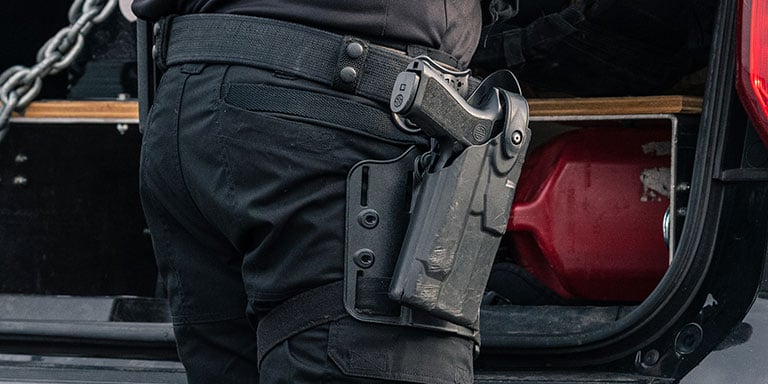
About departments issue duty weapons and holsters. However, with gun-mounted tactical flashlights and lasers, personally owned specialized holsters are mutual. A laser on a handgun is an essential law tool. During night fire qualification, some officers find it'southward like shooting fish in a barrel to shoot the unabridged class from the hip with laser-guided accuracy. Most departments allow these tactical add together-ons, simply they also set a minimum standard for the alternate holster.
Duty holsters are designated as retention level 1, level 2, or level 3. The levels indicate the number of actions necessary to remove the weapon from the holster. Level 3 holsters have the most safety features and crave the officeholder to take several actions to draw the weapon. With practice, these movements become second nature to a well-trained officer. About uniform patrol officers are required to acquit a level 3. A level 2 holster usually finds a home with detectives and other plainclothes assignments. The level one holster is nigh practical for off-duty curtained carry applications.
Shop Duty Holsters | Learn More nigh How to Choose a Gun Holster
Tasers
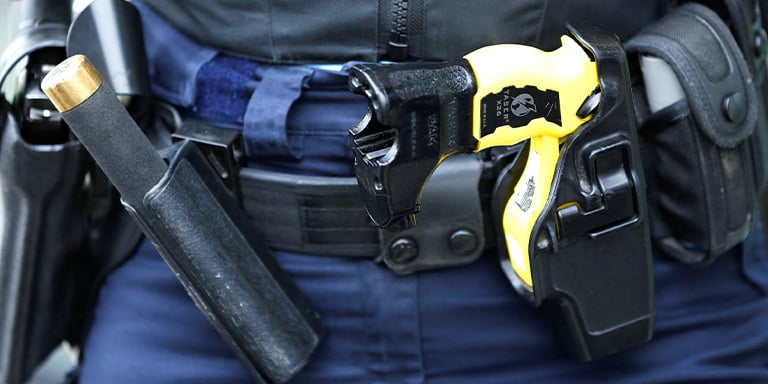
Officers are encouraged to habiliment their sidearm on their dominant side. Equally a result, tasers are ordinarily worn on the weak side, either necessitating a cross depict or requiring officers to draw their taser with their not-ascendant hand. The easiest method, though, is simply to call up that you should draw your firearm from your ascendant side, and you lot should draw your taser from your weak side.
More exceptionally (but not unheard of), police may continue their taser in a drib leg holster or on a holster attached to a vest; information technology merely depends on the uniform requirements of the job. Any the instance, drawing your taser, like every other detail on your duty chugalug, should go muscle retentiveness.
Store Taser Holsters
Handcuffs
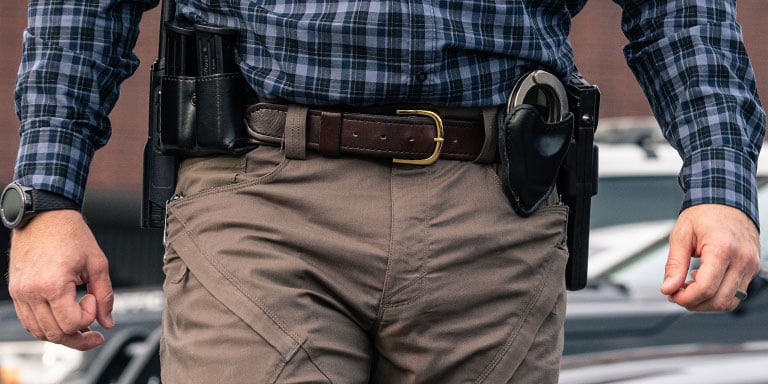
When it comes to handcuffs, you have two choices: hinged cuffs, which are attached by a hinge, or chain cuffs, which are attached by a few links of chain. Each has its advantages and disadvantages, but at that place is room for both on every officer's belt. Most officers carry 2 sets of cuffs for a couple of reasons. Consider the most obvious reason: responding to a fight call, y'all arrive first and intermission up a mutual fight, arresting both combatants. However, yous only have i set of cuffs. You lot'll probably end upward securing one person in the back of your patrol unit uncuffed while handcuffing the other.
There are too situations where a person, considering of their size, an injury or inflexibility, may crave 2 sets of cuffs hooked together to secure them. Hinged cuffs have tactical applications. With one cuff secured, a resisting suspect can be taken to the ground with an arm drag. The inflexibility of the swivel makes this possible. On the other end of the spectrum, you might find yourself in a situation where you pull over a senior denizen with a traffic warrant. Departmental policy requires you to handcuff all persons nether abort. In this situation, less restrictive concatenation cuffs might be more advisable.
Officers should e'er properly maintain their handcuffs. Keep the locking mechanism lightly oiled and work the activeness regularly so they open up and close smoothly. Engrave your badge number on them and so y'all can subsequently place your cuffs before they mysteriously disappear. Shop Handcuffs
You also need a proper handcuff key, not the little ones that come with about cuffs. Most officers carry a fundamental almost the size and shape of a pen, allowing for easier double-locking and unlocking. Many officers carry these clipped within their shirt pockets. Learn more than about how to use police handcuffs
Other Essential Equipment
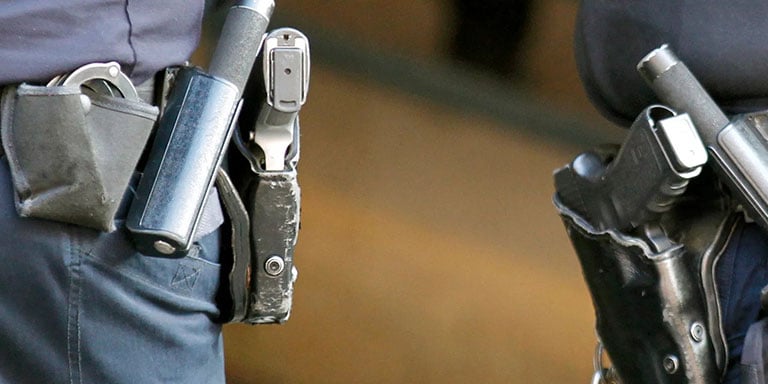
Handcuff cases come in many sizes and shapes. The most crucial signal here is your ability to access your cuffs rapidly. Cases can be either completely closed or partially open up. The closed cases require you to pull up on a flap, unsnapping the embrace before pulling out the cuffs. Open cases tend to be thinner and require only the action of pulling the cuffs out of the holder, making them a scrap faster to deploy. Deciding on a case comes down to personal preference, forth with trial and error. Shop Duty Cases
Pepper spray, when properly practical, is a valuable tool. It is very useful and is usually kept on the front of the belt where it can be speedily deployed. Make sure the spray button cannot make contact with anything else on your belt. The simply matter worse than having your pepper spray accidentally belch in your patrol motorcar is taking your unit out of service and explaining the error to your sergeant.
Most officers carry an expandable baton. What started out every bit the nightstick evolved to the side handle baton, and is at present the expandable baton. Information technology's mutual to carry it on your weak or support side, nigh merely non touching the radio. This helps to counterbalance the weight of the sidearm. The expandable baton is effective in crowd control situations. Merely pulling the baton and forcefully expanding it causes a precipitous snapping dissonance which has a similar upshot to racking the action of a shotgun: people hear the noise and understand the officer is serious. To that extent, it'southward very constructive. Store Batons
Magazine pouches and extra magazines are virtually universally located somewhere on the front of the duty chugalug. An officer should be able to keep their eyes on a threat while removing a new magazine from the pouch and reloading. Depending on the capacity of the sidearm, 2 fully loaded magazines in the pouch is typically the right balance between the added weight and not running out of armament. Many officers keep additional loaded magazines in their patrol-bag in the front seat of their vehicle. Shop Magazine Pouches
Organizing your duty belt is not an exact science. Officers are built differently, move differently and have different duties that may affect the mode they prepare their belt. While there are general guidelines and certain methods that are mutual, it'south up to each individual to decide how best to set their belt. The more you practice with your equipment and the more time you spend on the job, the ameliorate you'll understand which techniques work all-time for yous. What matters nearly is that your duty belt configuration is efficient, comfortable and allows you lot to practice your task to the best of your ability.
Did you lot observe this article helpful?

How To Set Up Duty Belt,
Source: https://tacticalgear.com/experts/how-to-set-up-a-police-duty-belt
Posted by: deciccobeirl1940.blogspot.com
0 Response to "How To Set Up Duty Belt"
Post a Comment